As our nation proudly enjoys its 250th anniversary, we celebrate not only 250 years of independence and resilience but also the extraordinary technological ingenuity that has helped preserve our freedoms. The advanced fighters, warships, drones, and surveillance systems that safeguard America and our allies are nothing short of mesmerizing. Yet behind the sleek airframes and powerful engines lies an invisible world of military electronic modules. These are the sophisticated brains and nervous systems that make modern warfare possible.
Where do these capabilities come from, and how do breakthrough technologies find their way into operational military systems? As we discussed in our recent post on revitalizing legacy military electronics, keeping proven platforms mission-ready remains a critical challenge. The old adage “don’t throw the baby out with the bathwater” reminds us that many proven platforms and modules still deliver tremendous value.
At the same time, the Department of Defense continues to push the boundaries with new technology. Bringing cutting-edge military electronic modules from concept to field capability is a demanding process that requires significant investment, rigorous testing, and often years of iteration. This deliberate pace protects our forces but means the most advanced commercial innovations don’t appear overnight.
The good news? Exciting advances are reshaping what is possible in military electronic modules right now. These developments offer practical pathways to enhance performance, reduce size and weight, and enable faster upgrades across both new and existing systems.
In this post, we explore some of the most impactful technology advances appearing in military electronic modules and how module design continues to evolve alongside them.
The Power of Modularity: MOSA and Open Standards
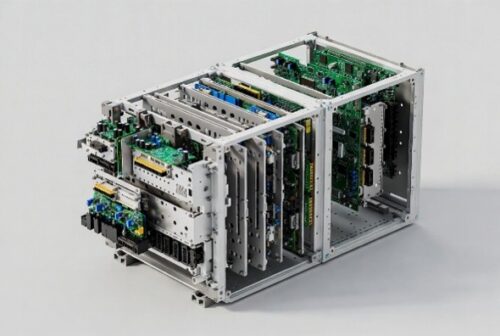
The Department of Defense has embraced the Modular Open Systems Approach (MOSA). This strategy encourages systems to be built from interchangeable modules that follow open, published standards. The result is greater flexibility: programs can upgrade or replace individual modules more easily as technology improves, without redesigning entire platforms.
Standards such as SOSA and CMOSS provide common interfaces and form factors. For engineers, this means more predictable integration. For a broader audience, think of it as moving from custom-built machines to a standardized toolkit where better components can be swapped in as they become available.
Smaller, Stronger, Cooler: Wide Bandgap Semiconductors (GaN and SiC)
One of the most significant material advances in recent years involves wide bandgap semiconductors, particularly gallium nitride (GaN) and silicon carbide (SiC). These materials handle higher voltages, switch faster, and operate at higher temperatures than traditional silicon. The practical outcome is electronic modules that are smaller and lighter while delivering more power or operating at higher frequencies.
This matters for radar systems, electronic warfare equipment, and power management circuits in aircraft, ships, and unmanned systems. Higher efficiency means less waste heat and often reduced cooling requirements. Better size, weight, and power characteristics (often called SWaP) are especially valuable on platforms where every pound and watt counts. These devices are already appearing in new radar and communication modules and are helping push performance boundaries in compact packages.
Packing More Performance into Less Space: Advanced Packaging and Chiplets
Traditional semiconductor design often relied on a single large chip fabricated on one process. Newer approaches use chiplets, smaller specialized dies that are combined in advanced packages. This heterogeneous integration allows designers to pair the best available technology for each function, such as high-speed digital processing alongside robust radio frequency or power management circuits, and greater flexibility in military electronic modules.
Military modules can now incorporate more computing power for tasks like real-time sensor processing or decision support in a smaller footprint. However, packing more capability into less space increases the importance of thermal management. Advanced substrates and specialized coatings play a growing role in keeping these dense modules reliable under extreme conditions. These innovations are also influencing module design and supporting advances in defense electronics manufacturing.
Intelligence at the Edge: AI and Machine Learning Enabled Modules
Another clear trend is the embedding of artificial intelligence and machine learning capabilities directly into electronic modules. Instead of sending raw data back to a distant central processor, modules can analyze information locally and make decisions in real time. This is valuable in electronic warfare, where a module might detect and respond to a threat signal almost instantly. It also supports sensor fusion on unmanned systems and helps maintain performance when communications links are jammed or bandwidth is limited.
The result is faster reaction times and greater resilience in contested environments. These intelligent modules are becoming important building blocks for collaborative combat concepts and autonomous operations.
The Real-World Bridge: Making New Advances Work with Legacy Systems
While new technologies generate excitement, most military platforms in service today were designed years or even decades ago. New military electronic modules must often interface with older data buses, power systems, and mechanical environments. Newer high-power density or high density designs also introduce fresh challenges around heat dissipation and electromagnetic compatibility.
This is where practical expertise in revitalization becomes essential. Updating legacy designs with modern equivalent components, redesigning circuit boards for better performance or compliance, applying advanced thermal management solutions, and conducting thorough testing to current standards allows proven platforms to remain effective. It also provides a pathway to insert new capabilities without waiting for a complete platform replacement. The goal is not to choose between old and new. It is to apply the right combination of approaches, so the force stays ready and capable at every stage.
Conclusion
As our nation continues to deliberate 250 years of freedom, American leadership in defense technology continues to rest on a foundation of bold innovation paired with disciplined engineering. The advances described here are expanding what is possible in military electronic modules, delivering higher performance in smaller packages, greater flexibility through modularity, and faster decision making at the edge. At the same time, the ability to sustain and intelligently upgrade the systems already fielded remains critical to maintaining our overall advantage.
Specialists who understand both emerging technologies and the realities of legacy system support help ensure that new capabilities can be adopted effectively and that existing platforms continue to deliver value. This combination of forward progress and practical sustainment helps keep the technological edge that supports our national security and the freedoms we celebrate. Freedom is not free, and staying ahead requires ongoing effort across the full spectrum of design, manufacturing, and sustainment.